
The information below is based on guidance from the State of Vermont. Vermont has adopted state-specific RRPM rules that are more stringent than federal EPA requirements. Contractors are responsible for complying with Vermont’s licensing, training, and supervision requirements. For official guidance, contractors should contact the State of Vermont directly.
Overview
Required Licenses
To perform lead-safe Renovation, Repair, Painting, and Maintenance (RRPM) work in pre-1978 residential rental properties, Vermont requires:
- Lead-Safe RRPM Supervisor License (individual supervising work onsite)
- Lead-Safe RRPM Firm License (company performing the work)
Notes:
- Sole proprietors must hold both licenses
- Companies need one Firm license, but each job site must have a licensed onsite Supervisor
The Supervisor may train other workers but must remain onsite at all times - Prior to getting these licenses, individuals must complete the training outlined in Step 1 below
Activities Considered RRPM (These activities are considered RRPM regardless of job size)
RRPM work includes, but is not limited to:
- Painting and surface preparation
- Window replacement
- Demolition of painted surfaces
Step 1: Initial Training Requirements
Before applying for licenses, individuals must complete:
- 8-hour Initial EPA RRP (“Lead Renovator”) Training
- Valid for 5 years
- 2-hour Vermont Inspection, Repair, and Cleaning (IRC) Practices Training
- Online, valid for 5 years
- Review Vermont RRPM Regulations for Workers
- Outlines differences from federal EPA rules
Where to find training:
These training providers are accredited to offer the RRP lead renovator training in Vermont. To see upcoming trainings, visit the provider’s website or select Education from the left menu options in the ALRP Licensing and Permitting Portal . If you cannot find an RRP training that meets your needs, please contact the provider to ask about future trainings.
- ATLAS Technical Consultants, LLC https://atctraining-newengland.com/
Atlas Technical Consulting, LLC offers RRP trainings in Williston, Vermont and West Springfield, Massachusetts.
- Evergreen Environmental https://evergreenehs.com/training/vermont-renovations-repair-painting-and-maintenance/
Evergreen Environmental offers Vermont-specific RRPM training and IRC training in locations around the state, as well as private classes. Evergreen now offers a combined RRPM Initial and IRC Practice certification with all RRPM trainings.
- Lead-Edu https://lead-edu.info/
All Lead-Edu training formats are approved. Lead-Edu offers an RRP refresher training that can be taken online at any time using an e-learning format (no live instructor). They also offer a hybrid initial RRP training with part of the training held online with a live instructor and the rest held in person for the 2-hour hands-on training.
- ProActive Safety Services https://proactivesafetyservices.com/calendar/
You can take the RRP lead renovator training in other states. For example, you can take the course in New York, New Hampshire or Massachusetts and then apply for a Lead-Safe RRPM Supervisor license in Vermont. Check neighboring states for conveniently located RRP trainings by searching:
- The EPA’s website https://cdxapps.epa.gov/ocspp-oppt-lead/training-search
- The Zack Academy website https://www.zackacademy.com/class/epa-lead-certification/lead-renovator-certification-initial
Step 2: Licensing
Apply for licenses via the State of VT portal https://vtalrp.imagetrendlicense.com/lms/public/portal#/login

RRPM Firm License: $300 (renewed every 5 years)
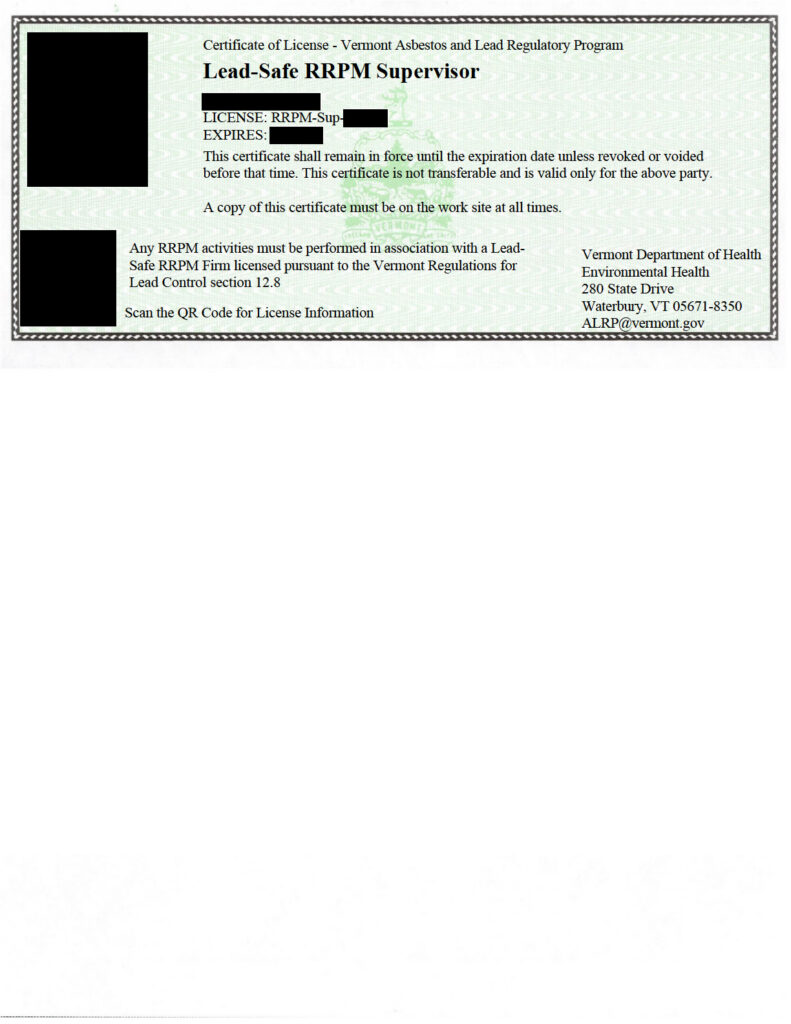
RRPM Supervisor License: $50 (renewed every year)
Maintaining Licenses
To remain licensed:
- 4-hour RRP Refresher Training before expiration
- In-person: valid 5 years
- Online: valid 3 years (next refresher must be in person)
- 2-hour Vermont IRC Practices Training every 5 years
- Review Vermont RRPM Regulations for Workers
⚠ If RRP training expires, the Initial RRP course must be retaken.
Contact
For questions regarding licensing or compliance, contractors should contact the Vermont Department of Health.
ALRP@vermont.gov
800-464-4343
802-863-7200
Sources
The information contained in this document was accessed via the State of Vermont Department of Health website for Renovation, Repair, Painting & Maintenance (RRPM) Regulations https://www.healthvermont.gov/environment/asbestos-lead-requirements/renovation-repair-painting-maintenance-rrpm-regulations on January 21, 2026.
Contractor Lead Paint FAQ
Q: I’m only replacing windows or doing a small amount of work. Is lead certification really necessary?
Yes.
In pre-1978 buildings, window replacement and similar work disturb painted surfaces that are presumed to contain lead. Window work is one of the highest lead-dust–generating activities. Even small jobs require an EPA RRP-certified firm and a Certified Renovator using lead-safe work practices.
Q: What license or certification do I need to work on pre-1978 rental properties?
You must have:
- EPA RRP Firm Certification (your business), and
- A Certified Renovator on staff or supervising the work.
Both are required for rental properties and child-occupied facilities.
Q: Why is this required?
Lead dust is a serious health risk, especially to children and pregnant individuals. Federal and Vermont regulations require lead-safe practices to protect occupants, workers, and property owners—and to ensure compliance during inspections, sales, and audits.
Q: What happens if I do the work without certification?
Uncertified work can result in:
- Fines and enforcement action
- Work stoppages or redo requirements
- Loss of eligibility to work on managed properties
- Liability for contamination or exposure claims
Q: How do I get EPA RRP certified?
- Take an EPA-approved RRP training course (1 day with in-person requirement) and Lead IRC certification test (Online or in-person).
- Apply for Firm License and Superivsor license through the State of VT.
- Renew certifications as required.
Training providers and application links are available at:
Q: Do these rules apply even if there’s no peeling paint?
Yes.
Lead rules are based on paint disturbance, not visible paint condition. Cutting, sanding, removing trim, or replacing windows triggers requirements regardless of appearance.
Q: Who is responsible for compliance on a job?
The contractor performing the work is responsible for:
- Proper certification
- Lead-safe work practices
- Cleanup and documentation
Property management will request proof of certification before approving work.